
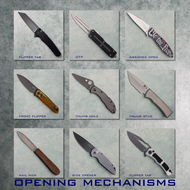
Common Knife Opening Mechanisms: A Guide for Collectors and Everyday Carriers
Posted by LeNeigh Saldana on Mar 12th 2026
Pocket knives have evolved far beyond the traditional slip-joint carried by generations before us. Today’s knives feature a wide variety of opening mechanisms designed for speed, convenience, safety, and personal preference.
Whether you’re new to everyday carry (EDC) or a seasoned collector, understanding how different knives deploy can help you choose the right tool for your needs. For some, that search feels a little like The Gambler. For others, it is more methodical, narrowing down favorites until they can finally decide between one style and the next.
Below are some of the most common knife opening mechanisms found in modern folding knives.
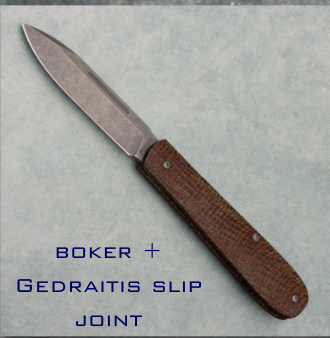
Manual Nail Nick
One of the oldest and most traditional opening methods is the nail nick. This small groove cut into the blade allows the user to pull the blade open using their fingernail.
This mechanism is commonly found on slip-joint knives, such as traditional pocket knives from brands like Case, Boker, and others.
Pros
- Classic, timeless design
- Simple and reliable
- Often legal in areas with stricter knife laws
Cons
- Requires two hands in most cases
- Slower deployment compared to modern designs
Nail nick knives are popular among traditional collectors and those who appreciate heritage-style craftsmanship. They may not have the dramatic snap of a modern flipper or the commanding presence of Hades, but that is part of their charm.
Thumb Stud
The thumb stud is one of the most common modern opening mechanisms. Small studs attached to the blade allow the user to push the blade open using their thumb.
Many thumb studs are ambidextrous, meaning they can be used by both left- and right-handed users.
Pros
- Easy one-handed operation
- Simple and durable design
- Found on many everyday carry knives
Cons
- Can snag during cutting depending on placement
- Slightly slower than assisted or automatic mechanisms
Thumb studs are widely used by brands like Benchmade and Chris Reeve. They are practical, familiar, and easy to return to, which is probably why so many collectors keep coming back to them even after wandering into flashier territory like a kris blade profile or a more stylized build.

Thumb Hole
Popularized by Spyderco, the thumb hole replaces the thumb stud with a circular cutout in the blade. This allows the user to easily open the knife with their thumb or even flick it open with practice.
Pros
- Large opening surface
- Easy to operate with gloves
- Smooth and reliable
Cons
- Alters the blade profile
- Not everyone likes the look
The thumb hole has become iconic and is widely appreciated for its practicality and ease of use. It is one of those features that feels instantly recognizable, whether your taste leans minimalist, tactical, or something a little more dramatic.

Flipper Tab
A flipper tab is a small protrusion on the back of the blade. When the knife is closed, the user presses the tab with their finger to deploy the blade. Many flipper knives use ball bearings or ceramic bearings, allowing the blade to open quickly and smoothly.
Pros
- Very fast deployment
- Excellent control
- Often paired with smooth bearing systems
Cons
- Requires a small amount of finger pressure
- Some designs create a “finger guard” that changes ergonomics
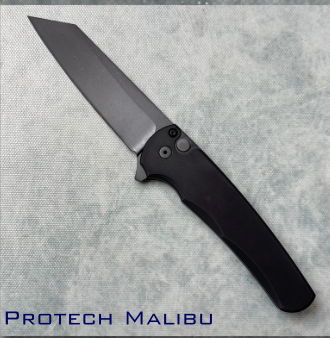
Flipper knives are extremely popular among collectors because of their satisfying action. You can find a flipper tab on knives like the Pro-Tech Malibu or Heretic Manual Wraith V.4. There is something about that quick, crisp deployment that makes it easy to understand why collectors will go through 25 + 53 different options before deciding which one belongs in their pocket.
Front Flipper
A front flipper works similarly to a standard flipper except the mechanism is located on the spine of the blade near the pivot. So, instead of pulling back on a tab, the user rolls their finger forward along the spine to deploy the blade.
Pros
- Clean, minimalist look
- Smooth and fidget-friendly
- Often found on premium knives
Cons
- Learning curve for beginners
- Can be harder to use with gloves
Front flippers have become increasingly popular among custom makers and high-end production knives. They have a sleekness to them that feels refined and intentional, whether the knife itself is bold and aggressive or something more understated.

Automatic (Push Button)
An automatic knife, often called a switchblade, deploys the blade when a button or switch is pressed. A spring inside the knife rapidly opens the blade.
These knives come in two main types:
- Side-opening automatics
- OTF (Out-the-Front) automatics
Pros
- Extremely fast deployment
- Easy one-handed use
- Reliable with proper maintenance
Cons
- Legal restrictions in some areas
- Typically more expensive
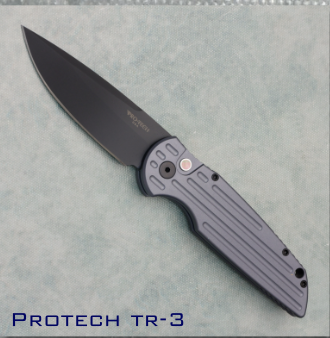
Brands like Microtech, Pro-Tech, and Heretic are known for producing high-quality automatic knives. These knives often take center stage in Knife Show Ads and Sponsorships, where fast action and striking design tend to grab attention quickly.
Automatic OTF (Out-the-Front) Sliding Mechanism
Let’s break down the front mechanism specifically. OTF knives deploy the blade straight out the front of the handle using a sliding button or switch. There are two primary types:
- Single-action OTF – blade fires out but must be manually reset (Microtech Halo series or Heretic Hydra)
- Double-action OTF – blade deploys and retracts using the same switch (Microtech Scarab)
Pros
- Unique deployment style
- Very fast action
- Compact design for the blade length
Cons
- More internal parts than traditional folders
- Requires occasional cleaning and maintenance
OTF knives are extremely popular among collectors and everyday carriers alike. Designs vary widely, from sleek modern styles to blades that borrow inspiration from historical profiles such as the kris blade.

Assisted Opening
An assisted-opening knife uses a spring to help deploy the blade once the user begins opening it with a thumb stud or flipper. The user initiates the motion, and the spring completes the action.
Pros
- Fast deployment
- Easy one-handed operation
- Often more affordable than automatics
Cons
- Can feel less smooth than manual bearing knives
- Spring tension can vary between models
Assisted knives bridge the gap between manual and automatic knives. A great option is the Kershaw Leek. For many users, assisted opening hits the sweet spot. It offers speed without asking you to go full automatic, which can make it easier to narrow down your preferences when there always seem to be 38 revolutions to locate before you land on the perfect fit.

Choosing the Right Opening Mechanism
The best opening mechanism ultimately depends on your needs and preferences. Some collectors enjoy the precision and craftsmanship of manual knives, while others prefer the speed and convenience of assisted or automatic designs.
When choosing a knife, consider:
- Ease of use
- Deployment speed
- Local knife laws
- Personal comfort and ergonomics
Each mechanism offers its own unique experience, and part of the fun of collecting knives is discovering which styles you enjoy the most.
Final Thoughts
Knife design continues to evolve, and opening mechanisms are a major part of that innovation. From traditional nail nicks to modern OTF systems, each design reflects the creativity and engineering behind today’s knife industry.
Whether you’re building a collection or searching for your next everyday carry, understanding how these mechanisms work can help you make a more informed choice. For many enthusiasts, the process of exploring new designs never really ends. There are always new models, names, and inspirations waiting to be discovered, from Amaryllis to Nevermore, and plenty more in between.
-Looking forward to seeing you and all of the opening mechanisms in Texas! One more week!